Steam
Store data
- Store status
- Coming soon
- Scheduled release
- 16 November 2026
- Positive reviews
- —
- Total reviews
- —
- Release date
- 16 November 2026
24-hour and 7-day views use hourly peaks from ten-minute samples. Longer views use retained daily peaks. Up to 24 recent event markers are shown per layer.
Recent views use Steam's daily review activity. Longer views use weekly totals, retained by SteamWatch.
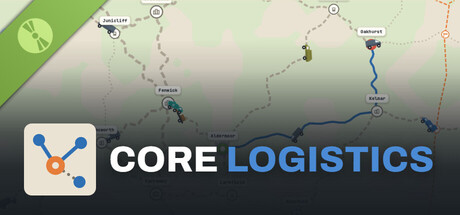
Start with a single van and grow into a freight network that covers the whole map. You choose which contracts to take, which trucks to buy, and which regions to open. The clock runs while you decide, and pauses whenever you need to think.
A new set of contracts appears on the board every 6 hours. Each one shows what it pays, what it carries, how far it goes, and how long the trip could take: a range from the fastest route to the cheapest.
You have a limited number of trucks and a limited number of contract slots, so taking one job means turning down another.
Every empty run to the next pickup costs fuel and earns nothing. Pick a second job that loads where the first one drops off, then a third — up to three jobs on one truck, run back to back, with no empty driving in between.
You set the order. Every job's deadline keeps running while the jobs ahead of it are driving, so the wrong order makes the last one late. The map draws the whole run and marks each point where one job's drop-off is the next one's pickup.
Rates for a type of cargo can rise for a day or two, or fall. Now and then one very large job appears on the board. Each change is announced when it starts, marked on the offers it affects, and counts down in the top bar until it ends.
Roads change too. An accident makes one stretch slower; a closure shuts it completely. New routes go around it, but a truck already on its way has to drive through it.
There are eight kinds of trucks to buy, across six classes, and eleven types of cargo. Refrigerated cargo needs a reefer, liquids need a tanker, and oversized loads need a Heavy Haul truck.
A bigger truck costs more to run, and it still cannot take a job your licenses do not cover.
Most licenses need the right trucks, a big enough company and enough reputation. Meet the requirements, pay the fee, and new work starts appearing on the board.
Licenses can also be lost. Sell the last truck that qualified you for one and it goes under review, then gets suspended: you can't take new jobs for that cargo until you re-certify.
From Tier 3 you can send freight through hubs instead of driving every load direct. Small trucks feed a hub, larger trucks run between hubs. Each hub only clears so much cargo at a time, and overloading one backs up everything behind it.
New regions open as the company grows, each with its own cargo and its own roads. There are five company tiers, from a local courier to an operator working in every region.
From Tier 4 you can write standing orders: rules that accept contracts matching conditions you set, and assign a truck to them without asking you.
Automation charges a commission, always takes the Balanced route and never chains jobs, so dispatching by hand still pays better on any lane you watch yourself. Jobs a rule holds back wait at the top of the Spot Market for your decision.
At a glance
Real-time management — pause whenever you need to plan
Grow from a single van into a freight network across the whole map
Chain up to three jobs onto one truck, with no empty driving between them
Eight trucks and eleven types of cargo , each with its own rules
Licenses that unlock new cargo — and can be suspended if you slip
Market and road events — rates that rise and fall, accidents, closures
Build hub networks — avoid bottlenecks
Expand into new regions
Five company tiers
Optional dispatch automation for routine work
Reputation that unlocks better contracts
Single-player · Sandbox
Steam currently lists 16 Nov 2026 as the release date.