Steam
Store data
- Store status
- Coming soon
- Scheduled release
- 30 November 2026
- Positive reviews
- —
- Total reviews
- —
- Release date
- 30 November 2026
24-hour and 7-day views use hourly peaks from ten-minute samples. Longer views use retained daily peaks. Up to 24 recent event markers are shown per layer.
Recent views use Steam's daily review activity. Longer views use weekly totals, retained by SteamWatch.
You are a colonist. A teleporter has appeared in a strange new world, and all it can give you at the start is a single drone and a small reserve of resources.
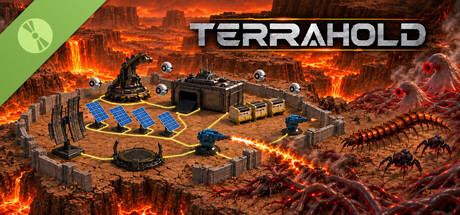
Around you stretches an endless procedural world of mountains, lava lakes, mineral and thorium deposits, dense growth, and pockets of alien life.
For now, they do not know you are here.
Terrahold is a strategy sandbox about base building, economy, and defense on a living planet. There are no missions or hand-crafted levels. Every run takes place on a new procedural map, and you decide how fast and how far your colony expands.
The teleporter is the heart of the colony. If it is destroyed, the run is over.
Robots construct and repair buildings, explore the map, and defend the base. They can make some decisions on their own, but from the strategic view you can still assign positions and targets directly. When you want to be in the fight or on the frontier yourself, switch to tactical control of a single defender or scout. That robot is under your full personal control, while the rest of the colony keeps working.
The colony depends on a shared power grid. Solar panels provide your first kilowatts, power lines connect distant outposts, and further expansion requires lava, thorium, thermal generators, and nuclear power plants.
Terrain is more than just an obstacle.
The Terraformer can tear down mountains and fill lava lakes, clearing space and creating new routes. Bridges can be built across narrow lava channels, shortening travel paths and allowing infrastructure to reach areas that were previously inaccessible.
Sometimes the best way around an obstacle is to change the map itself.
Your main enemy is not a set of scripted waves, but the planet's ecosystem. Vines spread across the land and damage infrastructure. Spiders gather in groups and strike from the fog. Eggs hatch new creatures, while spore colonies make the surrounding vegetation even more dangerous.
The farther your colony spreads, the greater the pressure becomes.
Walls and turrets help hold the perimeter, while force field generators can cover critical parts of the base with a protective dome. The field absorbs damage instead of the buildings and units beneath it, draining energy from the grid until its reserve is exhausted.
Keeping the teleporter alive is not enough. To win, you must open a permanent tunnel into the network of worlds.
That requires a massive surplus of energy. Explore the map, secure thorium deposits, expand the grid, and bring nuclear power plants online.
Hold the colony. Build the power. Open the link.
Endless procedural maps with varied terrain and resource distribution
Base building, resource extraction, and a shared power grid
Robots with partial autonomy and direct control when needed
Terraforming: remove mountains and fill lava lakes
Bridges across lava for new routes and infrastructure
Force fields that protect entire sections of the base by consuming grid energy
A reactive ecosystem instead of conventional scripted waves
Fog of war, exploration, and radar
Progression from solar power to thorium and nuclear energy
One objective: protect the teleporter and generate enough power to open a permanent tunnel
A new enemy: the Centipede. As the outpost grows, eggs can hatch a larger beast instead of a spider. It is tougher, hits harder, and strikes several neighboring cells at once — walls, wires, buildings, and units. Nearby spiders join the raid. It does not appear at the start; the colony has to grow first.Off-screen attacks no longer vanish. A damaged building outside the camera shows a colored edge arrow (yellow → orange → red as HP drops). Click it to jump the camera there. Walls and wires are not marked.Smarter targeting. Creatures no longer take long detours to a distant turret when a building, wall, or wire is already next to them. Wires are valid targets. Guards are still preferred over workers; turrets still matter if they are close enough.Plants. Thick growth in one cell no longer stacks into endless HP, so burning and clearing dense patches is more predictable.Other: fallen cre...
Read full update on Steam ↗Steam currently lists 30 Nov 2026 as the release date.
A new enemy: the Centipede. As the outpost grows, eggs can hatch a larger beast instead of a spider. It is tougher, hits harder, and strikes several neighboring cells at once — walls, wires, buildings, and units. Near…